WiMAX Physical Layer Implementation
Faculty of Engineering, Communication & Electronics Department · Helwan University
An end-to-end WiMAX (IEEE 802.16) physical layer, designed and implemented in VHDL on a Xilinx Spartan-3E FPGA. The system takes keyboard input, carries it through a full transmit/receive chain — channel coding, interleaving and OFDM modulation — and recovers it on screen, demonstrating the physical layer working end to end on a single board. Supervised by Dr. Fathy Zaki Amer.
What the project does
WiMAX (Worldwide Interoperability for Microwave Access) is a broadband wireless standard built around OFDM. The project focuses on its physical layer: the signal-processing chain that turns raw digital data into a modulated, error-protected waveform, and back again.
Enter a character on a keyboard, push it through a complete WiMAX transmit & receive chain on an FPGA, and read it back correctly on a monitor.
Data entered character by character (8-bit) on a PS/2 keyboard is encoded, interleaved and OFDM-modulated by the transmit chain, then demodulated, de-interleaved and decoded by the receive chain — all running on one Spartan-3E FPGA, with the recovered data displayed on screen.
Signal chain
Both halves of the link were implemented in VHDL and synthesised onto the same FPGA: a transmitter that protects and modulates the data, and a receiver that reverses every step to recover it.
Transmitter
- Keyboard input (PS/2)
- Convolutional & Reed–Solomon encoding
- Interleaver
- OFDM mapping & FFT
- Modulated output
Receiver
- Received signal
- IFFT & de-mapping
- De-interleaver
- Reed–Solomon & Viterbi decoding
- Data shown on monitor
Hardware & tools
FPGA platform
Xilinx Spartan-3E Starter Kit: FPGA fabric, PS/2 keyboard port, RS-232 serial ports and on-board/external clock sources used to drive and debug the design.
Design language
VHDL (with some Verilog) for every block: channel coding, interleaving, FFT/IFFT-based OFDM modulation, and the keyboard/display interfacing logic.
Error control
Convolutional coding and Reed–Solomon coding for forward error correction, with matching Viterbi-style decoding and RS decoding on the receive side.
From the presentation
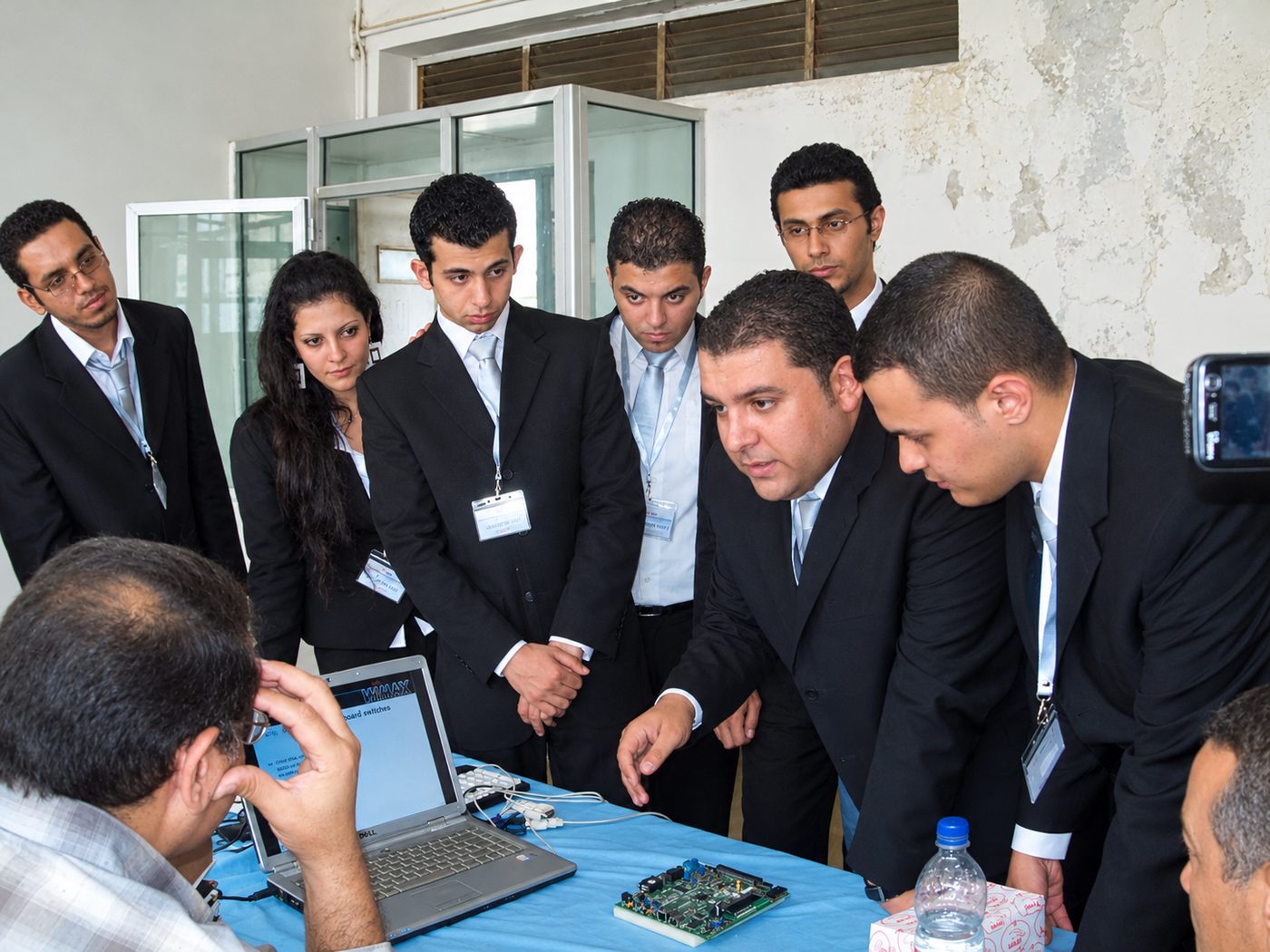
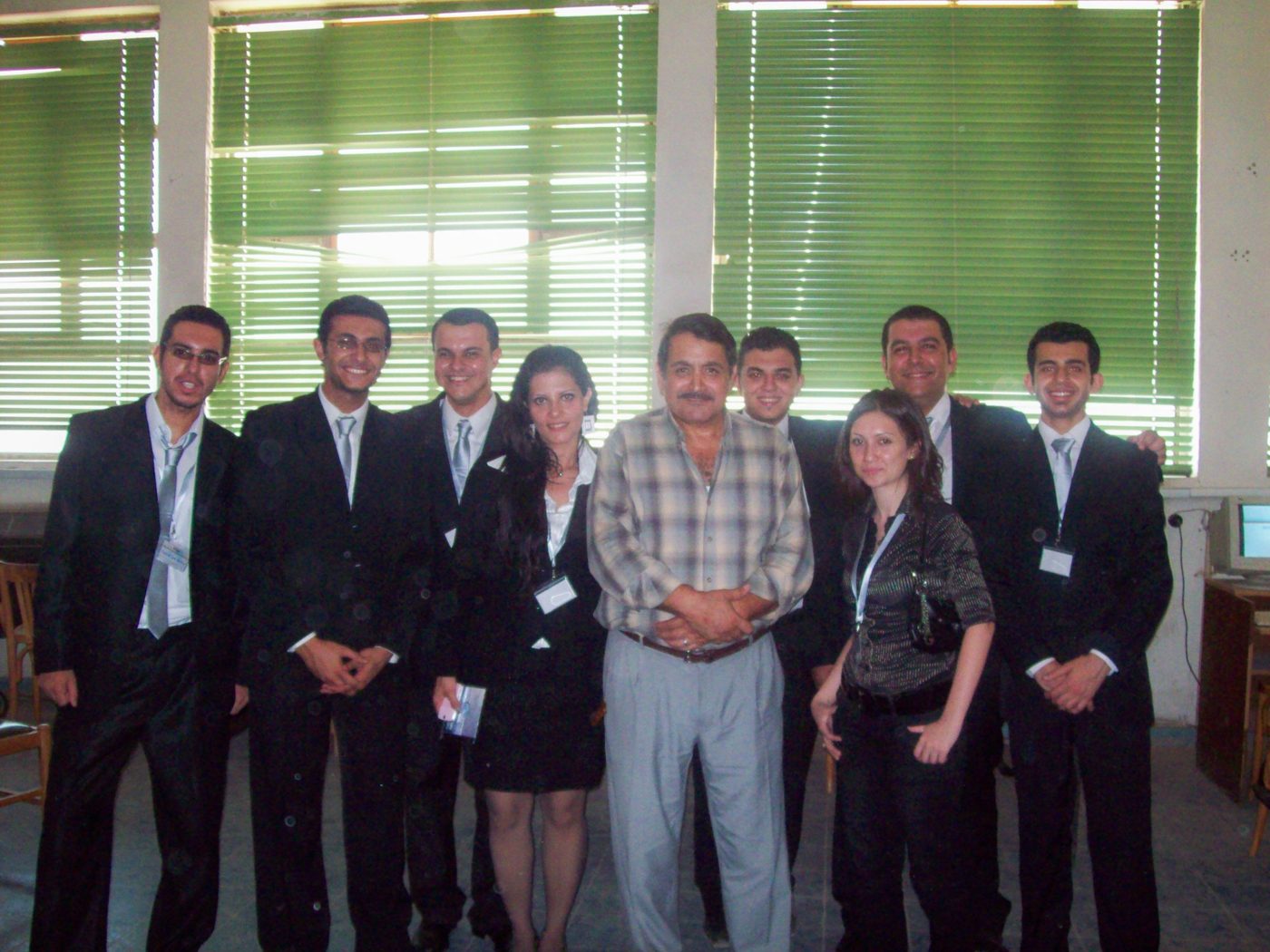
Demonstrating the board to faculty and reviewers at the graduation project showcase.


Full report
The complete write-up covers WiMAX fundamentals, FPGA and VHDL background, and the project's own design and code, in three parts.
WiMAX Physical Layer Implementation
Full graduation project report (PDF), Faculty of Engineering, Helwan University, 2009.
See the rest of my education and certificates.